

Why another equity screen?
Equity investors have always had a filtering problem.
There are tens of thousands of listed companies globally, but only a fraction can receive serious research attention. Equity screens help solve this problem by reducing a large investment universe into a manageable list of companies that exhibit characteristics an investor believes are associated with superior returns, lower risk, or mispricing.
A traditional value screen might search for companies trading at low earnings or book-value multiples. A quality screen might look for high returns on capital, strong margins and conservative balance sheets. A growth screen might prioritize companies increasing revenues and earnings significantly faster than their markets.
Screens are therefore not usually intended to answer the final question — “Should I buy this company?” They answer an earlier and arguably equally important question:
“Of all the companies I could research, which ones deserve my attention?”
The quality of that question matters because conventional screens have an inherent limitation: most are looking at the financial consequences of a business model rather than the behaviours that produce those financial results.
Accounting data is also necessarily backward-looking. A company can screen as cheap because its business is deteriorating, or expensive because its economics are improving faster than historical accounts reveal. High historical returns on capital do not necessarily tell us whether customers will still be there ten years from now.
So I have been exploring whether another variable might improve the investment funnel:
customer behaviour itself.
Could we systematically identify businesses whose products have become embedded in customers’ routines — and then determine whether that behavioural persistence translates into superior economics?
Starting with the conventional financial toolkit
Most equity screens begin with financial statements and valuation data. Some of the most common variables include:
Revenue growth measures how quickly a company’s sales are increasing. Persistent organic revenue growth can indicate increasing customer numbers, higher spending per customer, pricing power or expansion into new markets.
Margins measure how much of each unit of revenue remains after particular costs. Gross, operating and net margins provide different perspectives on the underlying economics and operating efficiency of a business.
Return on Invested Capital (ROIC) measures the operating profit a company generates relative to the capital required to run the business. Sustained ROIC above the company’s cost of capital is one of the clearest financial manifestations of an economic moat.
Free Cash Flow (FCF) is the cash generated by a business after the capital expenditure required to maintain and grow its operations. Unlike accounting earnings, it helps show how much actual cash the enterprise produces for shareholders, debt reduction, acquisitions and reinvestment.
Price-to-Earnings (P/E) compares a company’s share price with its earnings per share. It provides a simple indication of how much investors are paying for each unit of current or expected earnings.
Enterprise Value-to-EBITDA (EV/EBITDA) compares the total value attributed to the operating business — broadly equity value plus net debt — with earnings before interest, tax, depreciation and amortisation. It can be useful when comparing businesses with different financing structures.
These metrics are indispensable.
But by the time revenue, margins, ROIC and cash flow appear in a company’s accounts, something more fundamental has already occurred:
customers have repeatedly chosen to behave in a particular way.
They searched. Clicked. Watched. Ordered. Drank. Played. Transacted. Returned.
And then did it again.
That raises an interesting investment question:
Can behavioural conditioning itself be screened as an economic moat?
From Pavlov and Skinner to investing
The idea starts with two of the best-known concepts in behavioural psychology: classical conditioning and operant conditioning.
Russian physiologist Ivan Pavlov developed the foundations of what became known as classical or Pavlovian conditioning around the turn of the twentieth century. In his famous experiments with dogs, Pavlov demonstrated that an initially neutral stimulus could eventually trigger a physiological response after repeatedly being associated with another stimulus.
The basic relationship is:
Stimulus → Association → Conditioned Response
A bell associated repeatedly with food could eventually produce salivation even before the food appeared.
For investors, the interesting concept isn’t the dog or the bell. It is the cue.
Commercial environments are full of them.
A notification. A logo. A particular location. Hunger. Fatigue. A sporting event. A commute. Friday evening. The smell of coffee.
Repeated associations can make these cues increasingly powerful triggers of behaviour.
Pavlovian conditioning therefore asks: What predicts what?
A cue becomes associated with an anticipated experience or reward.
A second mechanism became particularly associated with American psychologist B. F. Skinner, whose twentieth-century work developed the theory of operant conditioning.
Here, behaviour is shaped by its consequences.
If an action produces a rewarding outcome, the probability of repeating that action can increase. If it produces an undesirable consequence, the probability can decrease.
The basic loop becomes:
Action → Consequence → Reinforcement → Repeated Action
For our purposes:
Operant conditioning asks: What happens when I do this?
Open an app and discover something entertaining.
Complete a lesson and maintain a streak.
Make a purchase and earn loyalty points.
Post something and receive social validation.
Search and immediately receive useful information.
Open a game and progress to another level.
The reward reinforces the behaviour.
Put Pavlovian and operant conditioning together and we get a potentially powerful commercial loop:
Cue → Action → Reward → Repetition → Habit → Retention → Monetisation
This is where behavioural psychology begins to become interesting to an investor.
The behavioural moat
Consider some ordinary behaviours.
The morning coffee.
Checking WhatsApp almost automatically.
Opening TikTok after receiving a notification.
Maintaining a Duolingo streak.
Browsing Amazon without knowing exactly what you might find.
Checking a portfolio when markets suddenly move.
Ordering food when hunger meets convenience.
Automatically reaching for the same beverage brand.
These are clearly not identical behaviours, and we should be careful not to reduce complex consumer decisions to simple psychological mechanisms.
But they have something important in common:
repetition can become conditioned.
That repetition potentially has economic consequences.
If a company can repeatedly turn environmental cues into customer actions, and those actions into sufficiently rewarding experiences, customer acquisition can gradually become customer habit.
That potentially changes the economics:
Conditioning → Frequency → Retention → Higher Lifetime Value → Lower Effective CAC → Stronger Unit Economics
And, in the best businesses:
Stronger Unit Economics → Reinvestment → Better Product → Stronger Conditioning
This is what I mean by a behavioural moat: a competitive advantage arising partly from persistent, reinforced patterns of customer behaviour that make demand unusually frequent, predictable or difficult for competitors to displace.
The investment question is whether we can identify and measure it.
Putting the concept into action
I have therefore been experimenting with a Behavioural Moat Equity Screen (BMES).
The objective is not to replace financial analysis with psychology. It is to move one step earlier in the causal chain.
Instead of beginning with:
Which companies have high ROIC?
we can first ask:
What is the customer repeatedly doing, why are they doing it, and how difficult is that behaviour to interrupt?
We can then investigate whether the strongest behavioural loops ultimately appear in the financial statements through retention, margins, pricing power, capital efficiency and free cash flow.
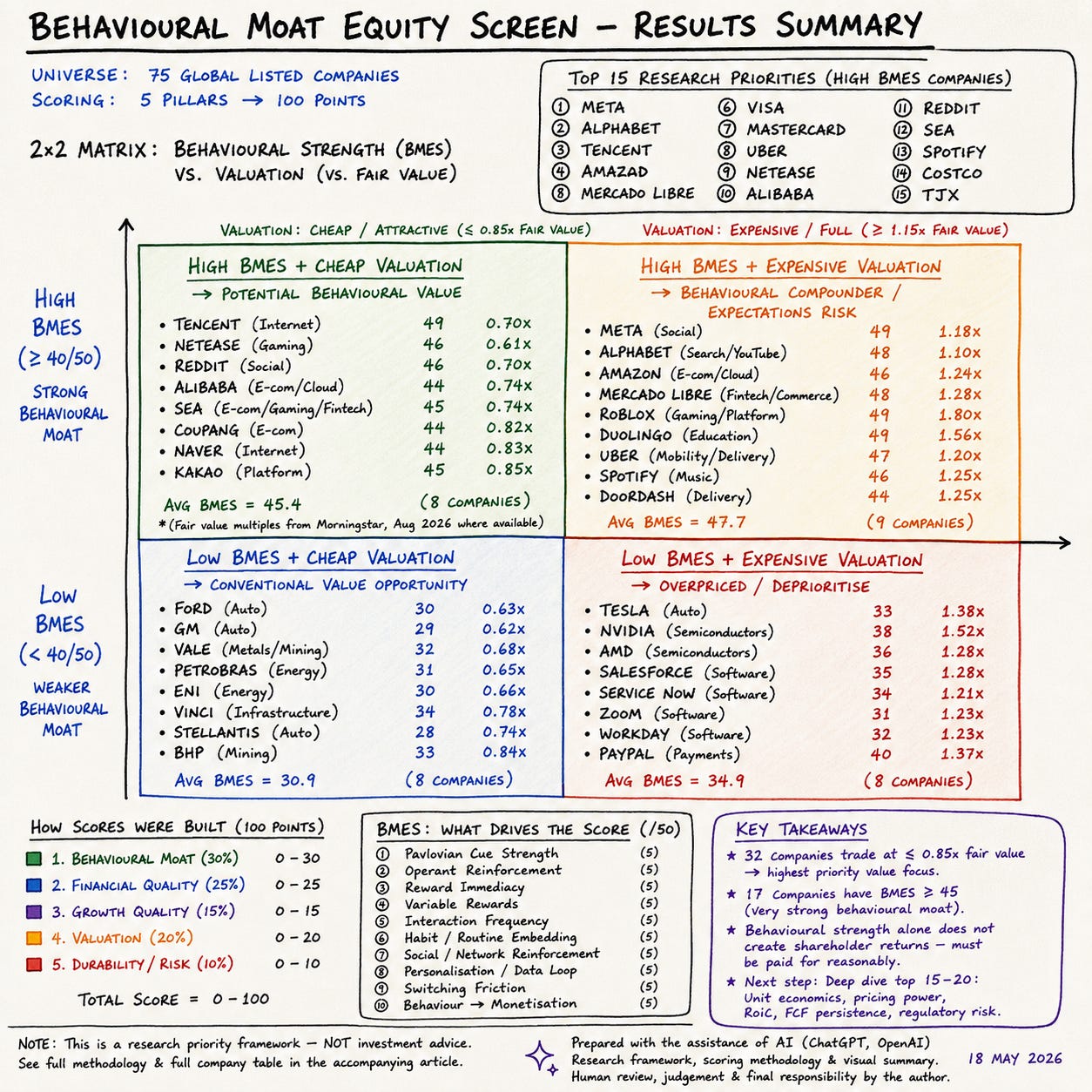
For the initial experiment, I constructed a universe of approximately 75 globally listed companies across technology, social media, gaming, e-commerce, payments, consumer goods, restaurants, retail, entertainment, fitness and other consumer-facing sectors.
Each company receives a Behavioural Moat score across ten dimensions:
Pavlovian cue strength — how strongly environmental or brand cues trigger product consideration or usage.
Operant reinforcement — whether using the product produces a meaningful reward that encourages repetition.
Reward immediacy — how quickly the user receives the benefit after taking an action.
Variable rewards — whether the outcome contains enough uncertainty or novelty to encourage repeated engagement.
Interaction frequency — how frequently customers can realistically engage with the product.
Habit formation — the extent to which repeated usage becomes embedded in everyday routines.
Social reinforcement — whether interaction with other users increases the incentive to remain engaged.
Personalisation — whether accumulated data makes the product increasingly relevant to the individual user.
Switching friction — whether history, identity, data, networks, familiarity or other factors make changing providers difficult.
Behaviour-to-monetisation — whether greater engagement actually translates into revenue and ultimately cash flow.
Each dimension is scored out of five, producing a maximum Behavioural Moat Equity Score of 50.
This produces the behavioural long list.
But that is only Stage One.
A great behavioural loop can still be a terrible investment
This distinction is critical.
A behavioural moat is not necessarily an investment moat at any price.
A company might possess extraordinarily powerful customer engagement while trading at a valuation that assumes decades of exceptional execution.
Another might generate intense engagement but struggle to convert that engagement into cash.
A third might have outstanding behavioural economics but face significant regulatory intervention.
And some forms of conditioning may create genuine social externalities that ultimately threaten the durability of the business model itself.
So Stage Two overlays conventional investment analysis.
The broader framework becomes:
Behavioural Strength × Financial Quality × Growth × Valuation × Durability
The initial 2×2 matrix provides a simple way of visualising the interaction between behavioural strength and valuation.
High behavioural strength + attractive valuation
→ Potential behavioural value
These may be particularly interesting because the market could be undervaluing the persistence of the underlying customer behaviour.
High behavioural strength + expensive valuation
→ Potential behavioural compounder — but with expectations risk
These may be exceptional businesses, but exceptional behaviour does not protect investors from paying too much.
Low behavioural strength + attractive valuation
→ Potential conventional value opportunity
The company may still be a perfectly good investment. Its thesis simply does not depend heavily on conditioned customer behaviour.
Low behavioural strength + expensive valuation
→ Generally the least interesting hunting ground for this particular strategy.
The matrix is therefore not intended to produce automatic buy or sell signals. It is a research prioritisation mechanism.
What are we actually trying to prove?
The hypothesis is ultimately more demanding than identifying companies whose products people use frequently.
It is this:
Does conditioned customer behaviour constitute an under-recognised intangible asset that produces measurably better retention, lower customer-acquisition costs, greater pricing power, higher incremental ROIC and more persistent free cash flow?
If the answer is yes, several relationships should eventually become observable.
Higher behavioural scores should, all else equal, be associated with some combination of:
higher retention → greater customer lifetime value → lower effective acquisition costs → stronger pricing power → higher incremental ROIC → more persistent free cash flow.
That is empirically testable.
And importantly, the relationship does not have to hold universally for the framework to be useful. It may prove particularly powerful in certain industries — digital platforms, consumer brands, gaming, marketplaces, restaurants or payments — and largely irrelevant in others.
We should also expect false positives.
A highly engaging product can be poorly monetised.
A powerful habit can disappear after technological disruption.
A variable-reward mechanism can attract regulation.
A great company can still be a bad investment at the wrong price.
Those are features of the research process, not flaws in the hypothesis.
From psychology analogy to investment framework
The next stage is therefore to test the highest-ranked companies against the numbers rather than the narrative.
For each candidate, we need to examine whether the behavioural score actually corresponds with:
retention and repeat usage;
customer acquisition economics;
organic revenue growth;
gross and operating margins;
pricing power;
ROIC and incremental ROIC;
free-cash-flow conversion;
balance-sheet strength;
valuation; and
regulatory and competitive durability.
The ambition is not to argue that Pavlov or Skinner discovered an investment strategy.
It is much narrower — and potentially more useful.
Financial statements tell us what a business has economically produced. Behavioural analysis may help explain why customers keep coming back to produce it.
If that behaviour is persistent, monetisable and difficult to displace, it may represent an intangible asset that conventional accounting captures imperfectly.
And if the market occasionally misprices that asset, behavioural science might help us identify economic moats from a different direction.
That is the proposition behind the Behavioural Moat Equity Screen.
And that is what we now need to test.
Research note: This framework is exploratory and intended for investment research and idea generation, not as a standalone investment recommendation. Behavioural scores involve judgement and should be validated against company-level operating and financial evidence.
AI disclosure: This research framework, screening methodology and article were developed with the assistance of ChatGPT (OpenAI), including support with research structuring, screening logic, synthesis and visualisation. The underlying investment thesis, interpretation, review and final responsibility remain with the author.