

This series was inspired by conversations with my daughter, who is studying A-Level physics, and the questions she brought home about what time actually is.
In 1995, a researcher at Bell Labs estimated it would take Africa fifty years to achieve meaningful banking penetration. The continent lacked the physical infrastructure — the branch networks, the ATMs, the credit bureaus — that Western financial systems had spent a century building.
He was wrong. Not because Africa built that infrastructure. Because it didn’t need to.
By 2026, Uganda has over 38 million registered mobile money accounts in a country of 50 million people, processing more than $70 billion in mobile transactions annually. The fifty-year roadmap was completed in under fifteen years. This is leapfrogging — and for the investor who understands what it means, it is one of the most powerful forces in the global economy.
The Geometry of the Skip
In established markets, development follows a predictable, expensive path. The United States spent over $400 billion building its landline telephone infrastructure across the twentieth century. American banks still spend an estimated $50 billion annually maintaining COBOL-based core systems built in the 1970s. Each generation of technology left behind a layer of legacy debt — sunk capital that shaped regulation, created incumbents with lobbying power, and slowed the adoption of better alternatives.
Uganda has almost none of it. Telephone landline penetration never exceeded 1% of the population. When mobile technology arrived, it landed on nearly bare ground. By 2010, mobile subscriptions outnumbered landlines by more than 40 to 1. By 2020, mobile money had displaced cash as the primary transaction medium for the majority of Ugandan households — a transition that took Kenya a decade and the United Kingdom is still completing.
The investment insight is counterintuitive: the absence of prior infrastructure is not a weakness. It is an asymmetric advantage. A frontier market isn’t buying the past of the West. It is building the future without the West’s accumulated drag, and doing it at a fraction of the cost.
Kampala as a Network Node
In Article 2, we established that cities scale super-linearly. As a city doubles in size, its economic output grows by approximately 1.15x per capita — meaning every doubling of population produces roughly 15% more output per person than before. Kampala’s population has grown from 1.5 million in 2010 to an estimated 4.5 million in 2026, a tripling in sixteen years. Under the super-linear scaling coefficient, that growth has not merely tripled the city’s economic output — it has multiplied it by closer to a factor of four.
But it is the structural shift that matters more than the raw numbers. Uganda’s landlocked geography historically imposed a transport cost premium of 30 to 50% on exports compared to coastal neighbours. The EACOP pipeline, stretching 1,443 kilometres from Hoima to the Tanzanian port of Tanga and representing a $5 billion infrastructure investment, fundamentally changes that equation for Uganda’s primary export commodities. Simultaneously, EAC integration has reduced the cost of moving goods from Kampala to the port of Mombasa from an average of $3,000 per container in 2015 to under $1,800 by 2025 — a 40% reduction in the metabolic cost of connection.
When you invest in this transition, you are not buying a country in isolation. You are buying a position in a network of 300 million East African consumers, at the moment before the connections begin generating super-linear returns.
The Mismatch That Creates the Opportunity
The most important concept in frontier market investing is not risk. It is metabolic mismatch.
Two clocks run simultaneously in any developing economy. The social clock measures how fast people adopt new behaviours. Uganda’s social clock is running fast: smartphone penetration is growing at approximately 15% annually, e-commerce volumes have doubled every two years since 2019, and the country’s median age of 16.7 years — the third youngest in the world — means the primary users of this infrastructure have never known a different system.
The institutional clock moves differently. Uganda’s commercial court backlog stood at over 14,000 cases in 2024. Land title registration covers fewer than 20% of parcels — a critical constraint on collateralised lending. A business permit that takes 2 days in Singapore takes an average of 24 days in Kampala.
Fast capital sees this 22-day gap and reads it as dysfunction. It reprices Ugandan assets at a discount of 30 to 40% relative to comparable East Asian frontier markets at equivalent development stages. It sells. Patient capital reads the same gap as a buying window. The network formation continues regardless of permit timelines. When institutions eventually close the gap, the market re-rates — and patient capital, already positioned, captures that re-rating in full.
The arbitrage is not about accepting higher risk. It is about correctly identifying which clock actually determines long-term value.
The Velocity of Money
In 2026, Uganda’s financial system completed its transition to ISO 20022 — the international standard for electronic data interchange between financial institutions. Cross-border settlement times within the EAC fell from an average of 3 to 5 business days to under 4 hours. Transaction costs on regional transfers dropped by an estimated 60%.
The value of a payment network does not grow linearly with the number of users. It grows approximately with the square of the number of connected participants — a principle known as Metcalfe’s Law. Uganda’s mobile money network had approximately 15 million active users in 2020. By 2026, that figure has grown to over 28 million. Under Metcalfe’s Law, the network’s potential value has grown not by a factor of 1.9 — but by a factor of roughly 3.5. The ISO 20022 transition extends that network across all six EAC member states, connecting Uganda’s 28 million active users to a regional addressable market of over 120 million.
That is not linear growth. That is a structural inflection.
The Proof of Concept: Where This Has Already Happened
The thesis described above is not speculative. It has already played out in at least five distinct markets over the past forty years. In each case, the pattern was identical: fast capital misread institutional friction as terminal risk, sold at a discount, and missed the re-rating when the network matured.
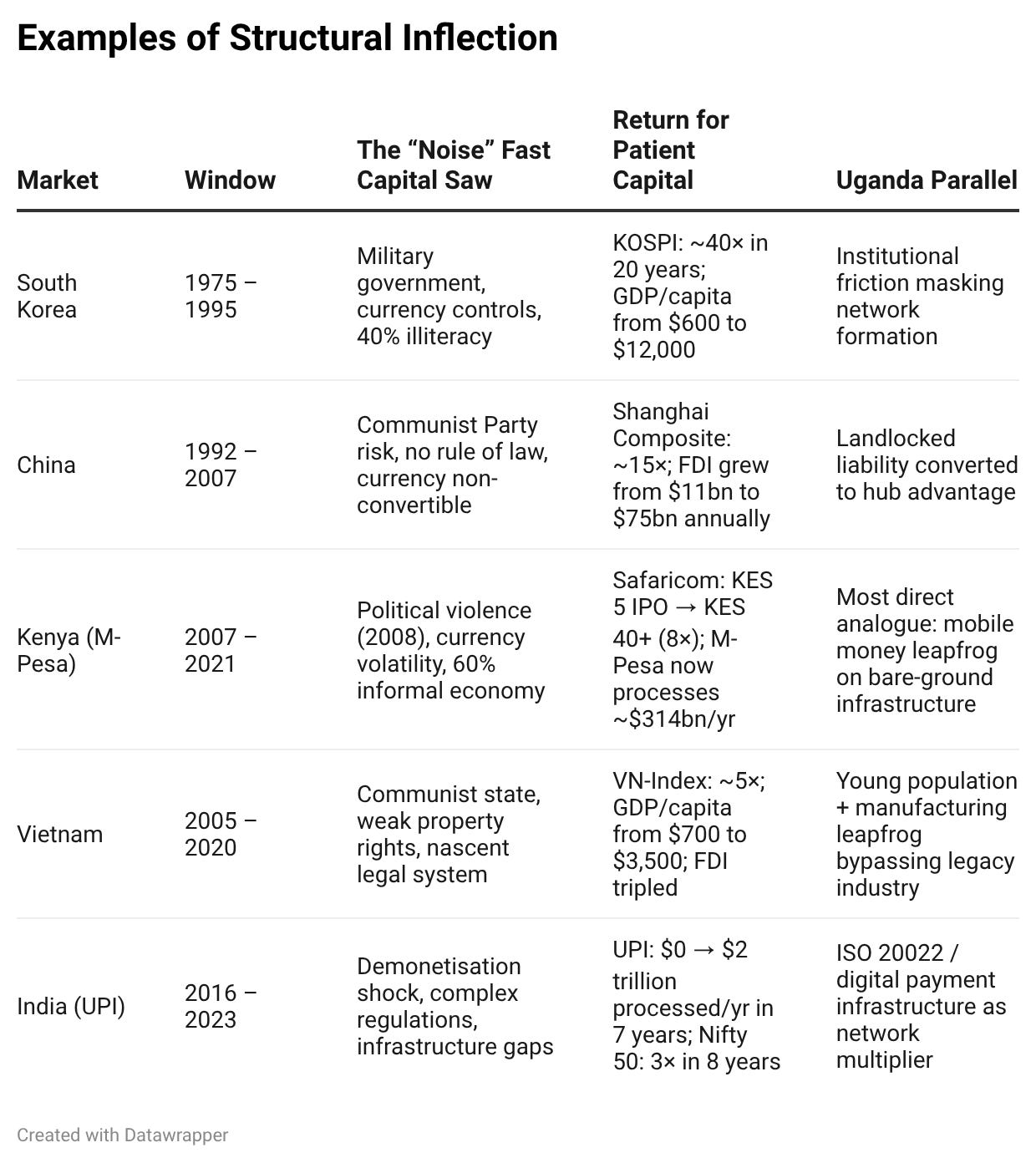
The Kenya case deserves particular attention because it is the most direct analogue to Uganda’s current position. When Safaricom launched M-Pesa in 2007, Kenya was two months away from the post-election violence that killed over 1,000 people and collapsed its tourism sector. Fast capital exited. The shilling fell 20% against the dollar. Analysts downgraded Kenyan equities across the board.
Patient capital that held Safaricom through that period — or bought during the panic — saw an 8× return over the following fourteen years. More importantly, M-Pesa’s network went on to process transactions equivalent to roughly 60% of Kenya’s entire GDP annually. The institutional clock (political stability, regulatory clarity) was noisy. The social clock (mobile money adoption, urban density, youth entrepreneurship) never stopped.
Uganda in 2026 is Kenya in 2009: the infrastructure is in place, the youth adoption curve is steep, and fast capital is still discounting the institutional friction rather than pricing the network formation.
What the Patient Investor Is Actually Buying
The unified theory tells us that wealth is created where energy meets network.
Uganda in 2026 is both at once. A population of 50 million — 75% of whom are under 30 — provides the energy: labour, consumption growth, and entrepreneurial formation at a rate most developed economies cannot arithmetically replicate. Uganda’s working-age population is projected to grow by approximately 1 million people per year through 2035. The rapidly scaling network — $70 billion in annual mobile transactions, a tripling of Kampala’s urban density in sixteen years, EAC infrastructure connecting 300 million consumers — provides the compounding structure that turns that energy into durable value.
The Ugandan shilling has averaged approximately 6% annual depreciation against the dollar over the past decade, largely offset by nominal GDP growth of 6 to 7% annually over the same period. Individual companies will stumble. Institutions will move slowly. None of these facts change the underlying geometry.
Five markets have already demonstrated that geometry. The network forms. The connections multiply. The re-rating arrives — and it arrives all at once, not gradually.
The best time to buy into a hub is when the world still thinks it is an outpost. The five precedents above suggest that window is measured in years, not decades.
It will not stay open indefinitely.
Professional overthinker. Occasional optimist. Building a platform for #InvestinAfrica - driving impact through capital, innovation, and technology.
See the rest of the articles in the series here:
Article 1, The Unified Theory of Investing: The Illusion of the Clock